

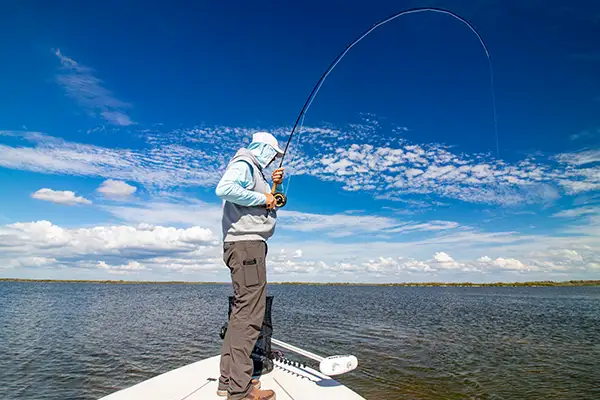
Mosquito Lagoon is a shallow saltwater protected body of water inside the Merritt Island National Wildlife Refuge, well known for its excellent sight fishing for redfish, black drum, seatrout, and more. I have been guiding fishing charters on these waters for over 20 years and specialize in sight fishing, which is casting to fish you can see in the water, fish that have their tails or backs out of the water, or other indications that there are fish you should cast to.
While this type of fishing is exciting, it often requires much more skill than other styles of fishing, such as live or dead bait. Over the many years I have been doing this, I have found there are three top keys to successful sight fishing trips. Most people think it would be the best color lure or fly, the best moon phase, the best time of year, or the best wind direction. None of these are nearly as important as the top three.
The absolute top three factors when it comes to sight fishing in Mosquito Lagoon are stealth, speed, and accuracy, in that exact order. If you are not quiet enough, you will never get close enough to the fish to catch them. If you take too long to react, they will be out of your reach before you can get them. If your cast does not land on the mark, it likely will not result in a bite. All of these things may not be something you are used to using in your normal fishing location, but they must be a priority here in Mosquito Lagoon.
Stealth
Stealth is at the top of the importance list. Stealth means no noises on the deck of the boat and no loud noises from lures or baits landing too close to fish. These are things we do not often pay attention to in our daily lives, such as a small squeak from your shoe as you turn to cast. Sound travels quickly underwater, and these well-educated fish all know the sounds of danger approaching.
Foot noise on the deck of the boat is the number one thing that I see scare away more fish week after week than anything else. As you are approaching fish, the calmer the water, the more you must pay attention to the slightest little noise your feet or other items create on the deck of the boat. Little things like setting down your fishing rod and making a small thump or clunk can scare away huge schools of fish from long distances.
Silence is key. Talking does not normally bother the fish, but anything on the deck of the boat is going to give away your approach.
Speed
Right behind stealth comes speed. Once you are quiet enough to get close to the fish, they are going to see or feel an object, your boat, which is much larger than them, approaching. As soon as they do, they are going to flee in terror and not be interested in eating.
Many times, clients on my fishing charters see the fish and turn around to show me that they see the fish, or point out to their friend that they see the fish. These precious wasted seconds give the fish an opportunity to start taking off, and the cast often arrives just seconds late.
Once you are in range, that rod tip should be moving and the cast should be on its way. If the cast does not hit the mark, you must reel in as fast as possible because the clock is ticking. The longer the clock ticks, the greater the chance the fish will see or detect us and take off.
Accuracy
Accuracy is closely related to the other two items, but it only matters if you are quiet enough to get there and fast enough to make the cast. The most accurate cast at fish that are fleeing at full speed does not matter much. Provided, however, you paid close attention to the first two rules, casts that land where they need to will always get more bites than casts that land behind fish, long distances away from them, or even inches away from them if they are busy digging their face into the grass trying to catch a crab or shrimp.
Many of the shots at our fish require lures, flies, or baits to hit a very small area. However, the cast cannot fall out of the sky onto their nose without spooking them. Casts must be made just past the fish and brought directly up into their path. Rarely, and I mean extremely rarely, will fish make a U-turn to get something behind them or even slightly veer off their path to get your cast that did not quite go where it should have.
This is something anglers should practice before going out on the water. Practice casting at various angles and distances, not just a one-size-fits-all cast for every target. Some fish are only 5 to 10 feet away. Some are 40 plus feet away. They may be on the backhand side or on the forehand side. Be prepared for all angles at all times.
What Matters Less Than the Top Three
Far, far behind those top three things are the questions of what should you use, what color should it be, and what time of year should you use a specific lure or fly. Even the greatest fly or lure ever invented, or the most delicious live shrimp, cannot get a bite if it is not in front of the fish.
No matter what you have, the top three factors are going to dictate your success. Pay attention to those, and you will catch many more fish.
If you're ready to work on stealth, speed, and accuracy while sight-fishing the shallow flats of Mosquito Lagoon, I offer year-round Mosquito Lagoon fishing charters with fly fishing or spinning tackle.