

The Most Common Shot Distances on Redfish Fly Charters (Realistic Expectations)
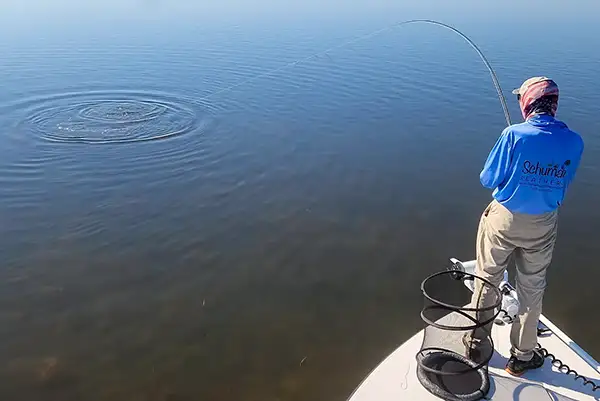
When anglers think about saltwater fly fishing for redfish in Florida, they often picture magazine-cover tight looped long casts that sail across the flat. Videos and social media make it look like every fish is caught at 70–80 feet, into the wind, with a perfect double haul. On real fly charters in Mosquito Lagoon and the Indian River Lagoon, that is not how most shots happen. Day in and day out, the fish, the water depth, and the way I position the skiff mean your best opportunities come at much more manageable distances.
Real Shot Distances on a Typical Redfish Fly Charter
On most trips, the majority of productive shots fall between 25 and 50 feet. That is the range where we can quietly pole into position, you can clearly see the fish or its sign, and you can deliver the fly with control. Many redfish are hooked in that 20–40 foot window—close enough to watch their body language yet far enough that they are not directly under the boat.
The long casts anglers worry about—anything near 70 feet—are rare. They show up occasionally on slick-calm days with spooky fish, or when a fish stops just outside the comfortable range before I can move the skiff. Think of those as bonus opportunities, not the standard you must live up to. If you arrive able to make consistent, clean presentations in the 25–50 foot band, you are well prepared for the shots you will actually see on the bow. If you can make long casts, it means we can stay farther away from big schools but it is not a requirement or the norm.
Why 25–50 Foot Shots Catch More Redfish
Redfish on shallow flats are often moving, and so is the boat. At 25–50 feet, you can manage all the variables that matter: leader turnover, landing noise, angle to the fish, and the strip once the fly hits the water. The shorter the shot, the easier it is to put the fly in the right lane and keep it there long enough for the fish to track and eat.
Once you start stretching past 50–60 feet, small mistakes get magnified. A loop that is slightly too open gets punished by the wind. The leader can pile up, the fly may land too close or too far, and the odds of lining the fish go up. In real guiding conditions, the angler who owns a repeatable 30–45 foot shot will out-fish the one who occasionally throws one 70-footer.
Speed on the Bow: Getting the Fly Out Now
When a redfish is in casting range, the clock is ticking. You rarely have time to false cast five or six times to build maximum distance. That is why shot speed is more important than raw distance. If you can pick the line up, make two or three crisp strokes, and send a 35–40 foot cast that lands accurately, you will convert far more opportunities than someone who needs extra time to work line out. If the casts misses the mark, one advantage of fly fishing is we can pick up the line and with one back cast lay it down in a different position. be prepared to do this numerous times throughout the day.
On my skiff, I coach anglers to stay “loaded and ready.” Keep enough line stripped off the reel for a quick cast, fly in hand, and line organized on the deck or in the stripping basket. When I call, “Redfish, 11 o’clock, 35 feet, moving left,” first you must acquire the target then you should start the cast immediately, not begin stripping line off the reel or untangling coils.
Accuracy Beats Brute Distance
At redfish distances, accuracy is everything. Your goal is to land the fly on a dinner-plate sized target in front of the fish—not just get somewhere in the general direction. For moving fish, that usually means leading them by a couple of feet so the fly crosses their path; for tailing fish, we may drop the fly much closer so they see it quickly.
unless you are casting sidearm, the only way to get a forward cast to straighten with the fly only a couple feet above the target is to have a back cast that unrolls going up. Tight loops with proper line speed help the fly cut through wind, turn over cleanly, and land where you need to place it.
Watch this video for a technique to make the most accurate casts.
How to Practice Realistic Redfish Distances
If you want to get ready before your trip, build your practice around the distances we actually use. Lay out a tape measure in the yard and mark 25, 35, 40, and 50 feet. Put a small target—paper plate, hoop, or hat—at each mark and keep score as you practice.
- Focus on quick deliveries: two or three false casts at most before you present.
- Practice into the wind, with the wind, and across it so you are not surprised on the skiff.
- Work on quiet landings: the leader should lay out straight, and the fly should land with minimal splash.
Even ten or fifteen minutes a day for a couple of weeks will build confidence. If you want to refine things further, review my articles on sight fishing techniques and choosing fly tackle for redfish to make sure your gear and approach match the conditions here.
Bonus Tip
The most common mistake I see in almost every fly fishing charter for redfish is the angler pulling the rod tip down near the water on the delivery before the loop was formed. This motion opens up the loop, hurts line speed, and destroys accuracy, especially in any wind. This almost always is a result of having upward traveling forward false casts. make all you false casts in the same manner and you will be able to predict where the fly will land without making a completely different delivery stroke.
Setting Expectations for Your Trip
Showing up with realistic expectations takes a lot of pressure off. You do not need to be a tournament caster to have a successful day of sight fishing. If you can comfortably deliver a fly between 25 and 50 feet, reasonably fast and reasonably straight, you are already in the game. On the water, I handle boat position, call out fish, estimate distance, and tell you exactly where to land the fly based on how the fish is moving.
Most of your opportunities will be those manageable 25–50 foot presentations, with an occasional closer or longer shot mixed in. Focus on speed, accuracy, and staying ready on the bow, and you will be prepared for the real-world distances we see every week on redfish fly charters near Orlando.
Ready to put those realistic distances to work? Learn more about my Orlando fly fishing trips or book a dedicated fly fishing charter in Mosquito Lagoon.